
Choosing a childcare centre is a major decision. Parents naturally want to know whether their child will be safe, supported, respected and given meaningful opportunities to learn.
Photos, reviews and centre tours can help, but families should also understand the National Quality Standard, commonly called the NQS. It provides a consistent benchmark for assessing the quality of approved early childhood education and care services across Australia.
The NQS is part of the wider National Quality Framework and covers seven areas connected to children’s learning, safety, wellbeing and development. Services are assessed by their state or territory regulatory authority and receive a rating for each area, as well as an overall rating.
Here is what each quality area means in practical terms—and what parents should look for when visiting a childcare centre.
1. Educational Program and Practice
The first quality area focuses on how children learn.
A quality program should be based on children’s ages, interests, strengths and development. Activities should have a purpose rather than simply keeping children occupied.
During a centre tour, parents can ask:
- How are activities planned?
- How do educators follow each child’s interests?
- How is a child’s progress shared with families?
- Are children given opportunities to choose, explore and solve problems?
Look for children who are actively involved in play, conversations, creative experiences and discovery. A strong educational program should support curiosity while allowing children to learn at their own pace.
2. Children’s Health and Safety
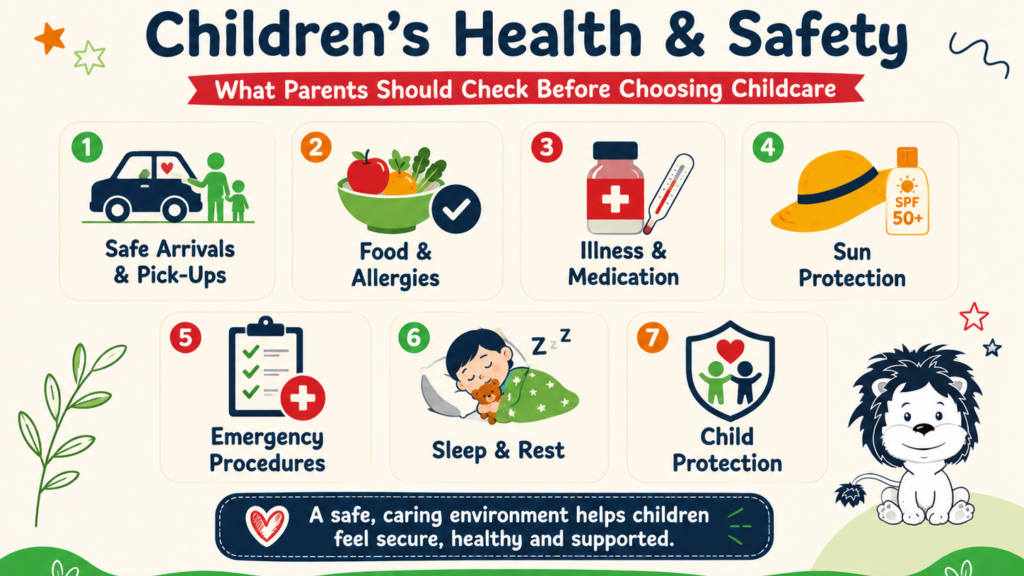
Health and safety are central to quality childcare. This area considers whether the service protects children’s health, comfort, safety and wellbeing.
Parents should observe whether the environment appears clean, organised and appropriately supervised.
Ask about:
- Safe arrival and collection procedures
- Food, allergies and dietary requirements
- Illness and medication policies
- Sun protection
- Emergency procedures
- Sleep and rest routines
- Child protection practices
The centre should answer clearly and confidently. Families should feel comfortable asking questions about how risks are managed.
3. Physical Environment
The learning environment should be safe, suitable and designed to support children’s development. The NQS recognises that indoor and outdoor spaces can contribute directly to play, movement, creativity and exploration.
When visiting, look beyond whether the centre appears attractive.
Consider whether:
- Resources are accessible to children
- Rooms feel calm and welcoming
- Children have space to move and play
- Outdoor areas encourage active exploration
- Equipment is age appropriate
- Children’s work and interests are visible
- The environment offers both active and quiet spaces
A thoughtfully prepared space can help children feel secure, independent and ready to learn.
4. Staffing Arrangements
This quality area looks at whether the service has appropriate staffing arrangements and qualified educators.
Parents do not need to understand every qualification requirement, but they should feel comfortable asking about the educator team.
Useful questions include:
- Who will care for my child each day?
- How does the centre support continuity of care?
- What qualifications and experience do educators have?
- How are new children supported while settling in?
- How does the centre manage educator absences?
Observe whether educators appear engaged with children rather than simply supervising the room.
5. Relationships with Children
Warm, respectful relationships are one of the clearest signs of a positive childcare environment.
Educators should listen to children, respond to their needs and support them with patience. Children should be treated as individuals whose feelings, cultures, ideas and communication styles are valued.
During a visit, notice whether educators:
- Speak calmly and respectfully
- Comfort children when needed
- Join children’s play
- Encourage rather than control
- Give children time to respond
- Support positive behaviour without humiliation
Parents should pay attention to how the environment feels. Children who feel safe and connected are more likely to participate confidently in learning.
6. Partnerships with Families and Communities
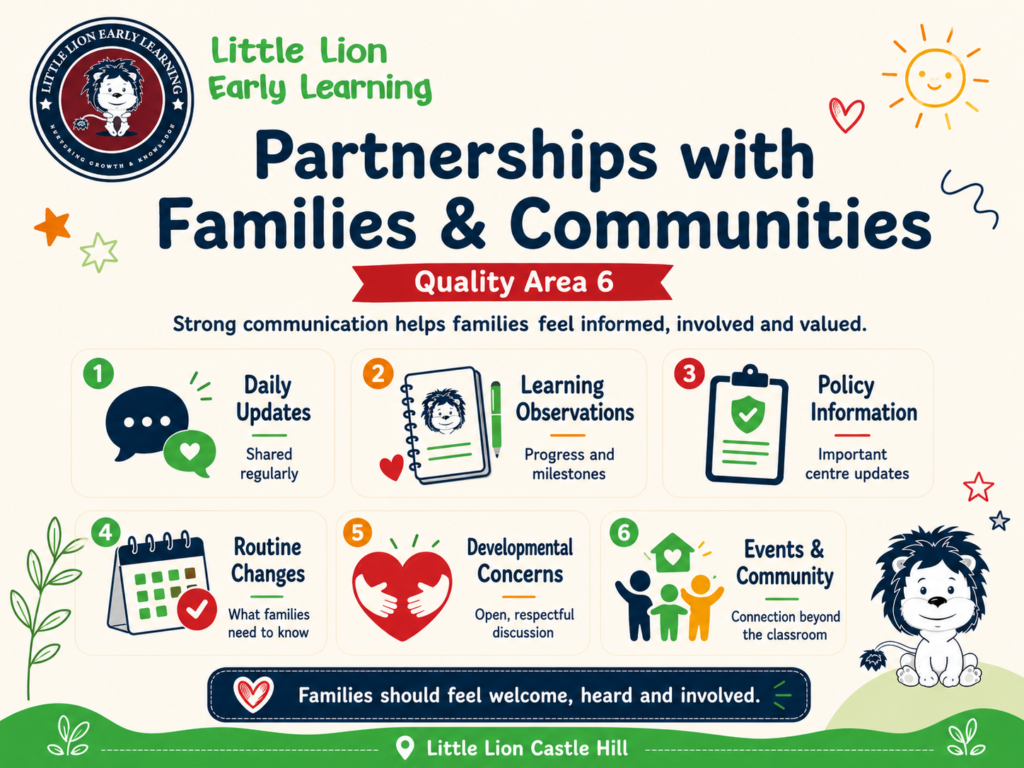
Good childcare should feel like a partnership between families and educators.
This quality area considers how centres communicate with parents, respect family knowledge and build links with their wider community.
Ask how the service shares:
- Daily updates
- Learning observations
- Important policy information
- Changes in routines
- Developmental concerns
- Events and community activities
Families should feel welcome to ask questions and contribute information about their child. Communication should go beyond occasional newsletters.
7. Governance and Leadership
The final quality area looks at how the service is managed.
Strong leadership supports clear policies, professional practice, continuous improvement and accountability. Parents may not see every part of centre management, but they can still look for signs of good organisation.
For example:
- Enrolment information is clear
- Policies are available
- Questions receive consistent answers
- Responsibilities are well defined
- Feedback is welcomed
- The centre can explain how it improves its practices
A well-run service creates stability for children, families and educators.
Understanding Childcare Quality Ratings
Approved services receive one of five overall ratings:
- Excellent
- Exceeding National Quality Standard
- Meeting National Quality Standard
- Working Towards National Quality Standard
- Significant Improvement Required
Families can view a service’s rating through official national registers and the Starting Blocks childcare search service. Ratings are designed to help parents compare services and make informed decisions.
A rating is useful, but it should not be the only factor. Parents should also visit the centre, observe educator interactions and consider how comfortable their child may feel there.
Final Thoughts
The National Quality Standard helps turn the idea of “quality childcare” into seven areas parents can actually investigate.
A strong centre should be able to explain how it supports children’s learning, safety, wellbeing, relationships and sense of belonging. Parents should feel informed, welcomed and confident—not rushed into making a decision.
Before choosing a service, check its official quality rating, arrange a tour and observe how children and educators interact. The best childcare choice is one that meets recognised standards while also feeling right for your child and family.
FAQs
1. What is the National Quality Standard?
The NQS is Australia’s national benchmark for assessing the quality of approved early childhood education and care services.
2. How many NQS quality areas are there?
There are seven quality areas covering educational programs, safety, environments, staffing, relationships, family partnerships and leadership.
3. Where can parents check a childcare centre’s rating?
Ratings can be checked through Starting Blocks and ACECQA’s national registers.
4. Is “Meeting National Quality Standard” a good rating?
Yes. It means the service meets the national benchmark across the assessed quality requirements.
.